Reimagining satellite TV with DVB-I and HbbTV
This article is part of a series based on presentations from the HbbTV Symposium and Awards 2025, bringing together insights from across the industry on the future of broadcast services and connected television. Covering topics from broadband-only delivery and addressable advertising to interoperability and evolving standards, the series captures key discussions and expert perspectives shaping the next phase of HbbTV and the wider TV ecosystem.
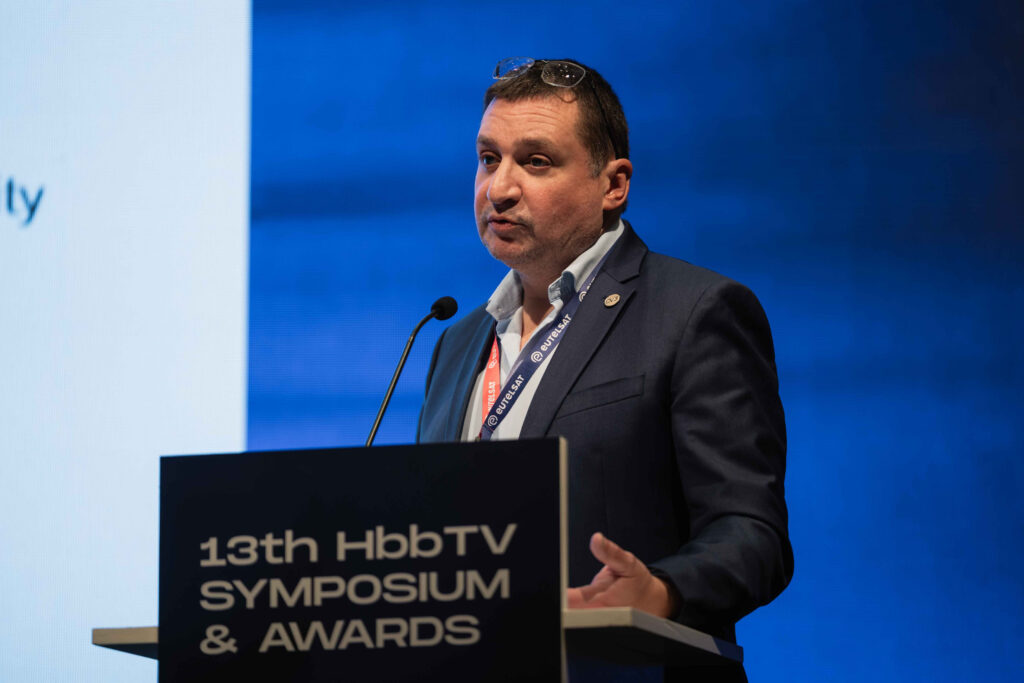
Ralph Edeine, Director D2C Platform & Advanced TV Solutions at Eutelsat
At the HbbTV Symposium 2025, Ralph Edeine, Director D2C Platform & Advanced TV Solutions at Eutelsat, presented a vision for the future of satellite television, one that combines the scale and reliability of broadcast with the flexibility and intelligence of IP-based services.
His starting point was a recognition of both strength and challenge. Satellite remains one of the most powerful distribution platforms in the world, reaching millions of households and delivering thousands of television and radio channels. However, the rapid rise of OTT services has fundamentally changed viewer expectations, particularly in areas such as user experience, content discovery and interactivity.
As Edeine noted, the best user experiences today are often found in streaming applications, where interfaces are rich, personalised and easy to navigate. For satellite operators, this creates an urgent need to evolve.
The approach taken by Eutelsat is to embrace hybrid delivery, combining broadcast with broadband through open standards. Rather than developing proprietary solutions, the company has chosen to build on DVB-I for service discovery and HbbTV for user experience and interactivity.
DVB-I plays a central role in this architecture. It enables the creation of unified service lists that can include both broadcast and OTT channels, simplifying installation and improving navigation. For satellite services, this removes traditional limitations such as long channel scans and inconsistent channel ordering. With DVB-I, hundreds or even thousands of channels can be installed and organised in seconds, with rich metadata integrated directly into the device interface.
HbbTV complements this by enhancing the user experience. It enables the delivery of electronic programme guides, interactive features and additional services that bring satellite viewing closer to the expectations set by streaming platforms. Together, DVB-I and HbbTV create a consistent and modern interface across both connected and non-connected environments.
A key example of this approach is the Sat.tv Connect service. Designed to improve the user experience of free-to-air satellite television, it combines DVB-I service discovery with HbbTV-based interfaces to deliver structured channel lists, enriched programme guides and additional features.
This represents a significant step forward from traditional satellite experiences, where channels are often presented in random order with limited metadata. By organising content by language or region and providing a full electronic programme guide, the platform makes it easier for viewers to discover and navigate content.
Importantly, the solution is designed to work across a wide range of devices. For non-connected markets, low-cost set-top boxes can deliver a basic enhanced experience using broadcast data. For connected TVs and hybrid devices, DVB-I and HbbTV enable a more advanced and flexible interface, fully aligned with open standards.
Beyond user experience, monetisation is a critical driver. Edeine highlighted how HbbTV enables the introduction of analytics and advertising capabilities into satellite environments. By embedding tracking mechanisms within applications, broadcasters can gain insight into audience behaviour, including viewing patterns and geographic distribution.
This data forms the foundation for more advanced services, including addressable advertising. By combining the reach of satellite with the precision of digital advertising, broadcasters can create new revenue streams and improve the effectiveness of their campaigns.
The integration of FAST channels is another example of this hybrid model in action. By referencing streaming-based channels within the satellite service lineup, platforms can expand their content offering and increase visibility for new services, while maintaining the scale of broadcast distribution.
Looking ahead, Edeine positioned hybrid delivery as a key step in the broader transition towards IP-based television. While full IP distribution remains a longer-term goal, technologies such as DVB-I and HbbTV provide a practical pathway, enabling gradual evolution without disrupting existing services.
His conclusion was clear. The future of satellite television is not about replacing broadcast, but enhancing it. By combining broadcast reliability with broadband intelligence, hybrid solutions can deliver a more engaging, measurable and monetisable viewing experience.
In this model, satellite does not compete with streaming. Instead, it becomes a complementary platform, capable of delivering both scale and sophistication in an increasingly connected television ecosystem.
Watch the presentation and explore further
You can watch the full presentation from the HbbTV Symposium 2025 here: Watch the Video
The presentation slides are also available to download: Download the presentation
Next in the series
Learn how the HbbTV OpApp is enabling linear channels to transition into an IP-delivered world, as Jeff Hunter explores how operators can combine broadcast and broadband to maintain familiar viewing experiences while adapting to an all-IP future.